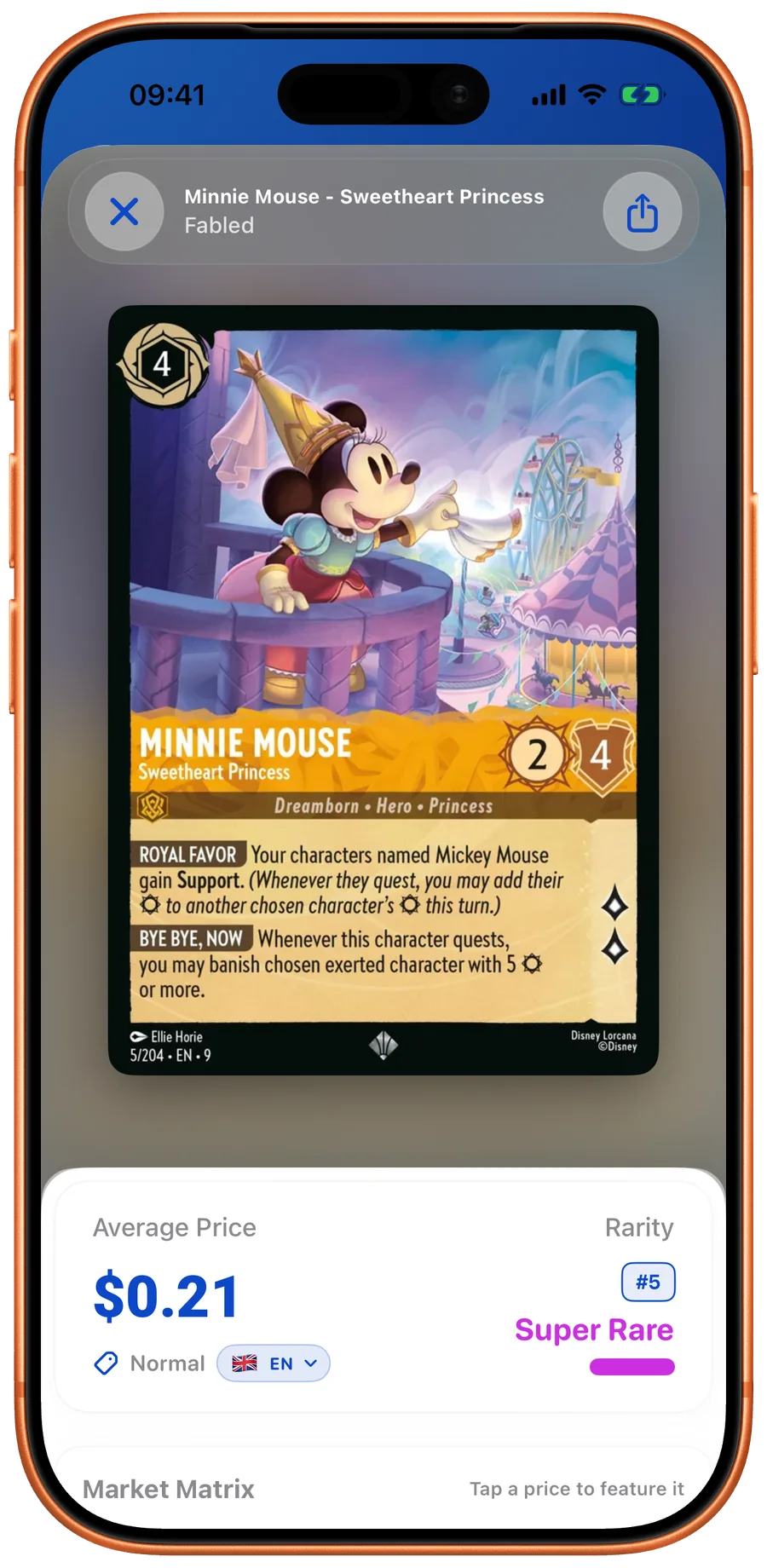
Lorcana Master Set vs Playset: Decide Which Cards You Still Need
A playset usually aims for four copies of each full card name you want to play. A master set aims to collect the versions you have chosen to include, often separating normal and foil printings. Those goals produce different missing-card lists. Decide which list you need before treating duplicates as spares or buying another version.
At a glance
- For collecting, define the set, language, finishes and special printings you will count.
- For a usual four-copy playing target, combine copies with the same full card name across printings and finishes.
- A completed ownership checkbox does not tell you whether you own four copies.
| Goal | Count by | What remains missing |
|---|---|---|
| One-of-each binder | Each printing and finish you chose to include | Any selected printing/finish with no owned copy |
| Four-copy playset | Full card name, including a character’s version | Enough additional copies to reach your chosen target of four |
| Both | Keep the two counts alongside each other | A card can meet one goal while still falling short of the other |
Write down what your master set includes
Collectors use “master set” for different scopes. Name the expansion and language, then decide whether you want one normal copy, normal plus foil, or additional special printings. List any promos or alternate versions explicitly. Do not assume that a box’s base-card count includes every printing you want. There is no useful completion percentage until your target list is clear.
Count a playset by the full card name
The current Constructed rules normally limit a deck to four cards with the same full name, with exceptions written on particular cards. For a character, the name and version together form that full name. Different art, set numbers or finishes do not by themselves create another full name. Four copies is a useful inventory target, not a requirement to play four in every deck. Check your format’s legality and any card-specific exception separately.
The same four cards can leave two binder gaps
Consider Aladdin – Prince Ali from The First Chapter (69/204) and its Fabled printing (92/204). Both printings appear in the catalog with normal and foil finishes. For this counting example, suppose your inventory has three normal First Chapter copies and one foil Fabled copy. You have four copies of that full name. If your collecting target is one normal and one foil of each of these two printings, you still need the First Chapter foil and the Fabled normal. This checks one card across two printings; it does not declare either entire set complete.
- Playing target: 3 + 1 = 4 copies; no extra copy is needed for that four-copy target.
- Selected printing/finish target: 2 of the 4 chosen combinations are present; the other 2 are missing.
- The two extra normal First Chapter copies are duplicates for that binder target, but they still contribute to the playing target.
Turn your inventory into the right missing list
First record what you physically own by printing, finish and quantity. For the binder list, compare each selected printing/finish with your one-copy target. For the playset list, add the usable copies of each full name and compare that sum with your playing target. Note borrowed cards and copies you have reserved for another deck. If you want two decks ready at the same time, decide whether the same physical copies can move between them before buying more.
Use checkboxes for presence and quantities for copies
The website’s set checklists mark whether you own a cataloged printing and finish. They do not count duplicate copies, and browser marks do not sync with the app. LanaKit’s iOS and Android collections let you record quantities and finishes. Compare those records with your chosen targets manually. Keep your chosen scope with your list so that “complete” means the same thing next time you sort the binder.
Sources and further reading
Related guides
LanaKit
Keep track of every copy.
Scan a card, confirm the printing and finish, then add it to your collection. Browse cards, build decks and check available price estimates.